
Costs of buying a first home in WA
By Nathan Ellis · Updated 2026-07-06
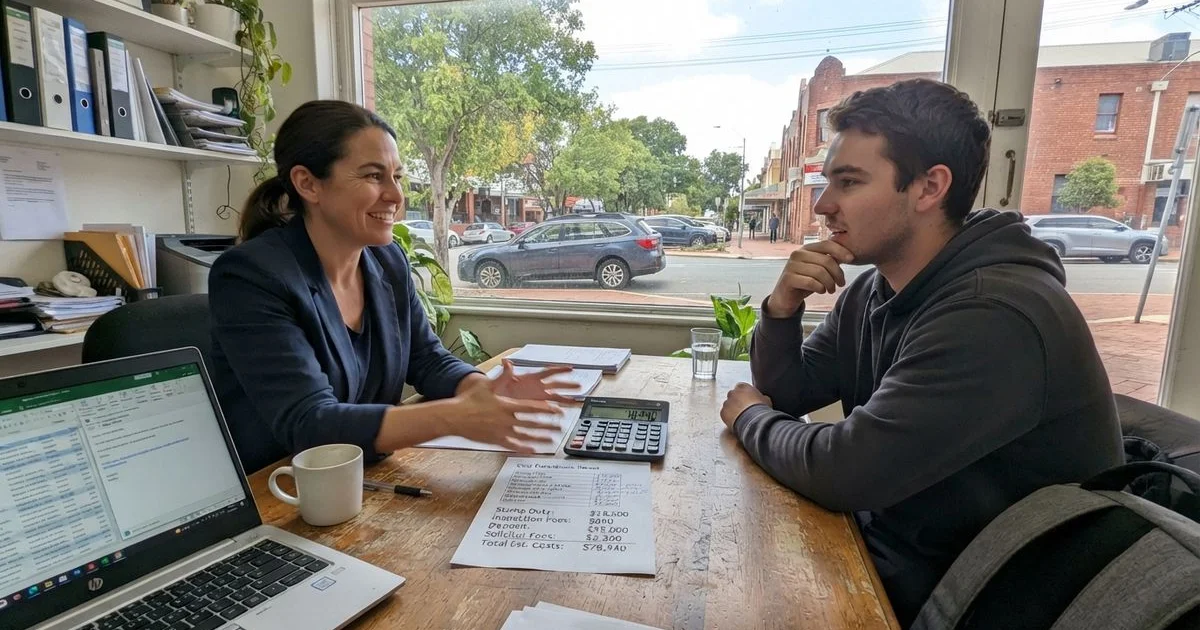
The costs of buying a house in WA go well beyond the deposit. On top of it you pay transfer duty (stamp duty) and Landgate’s fees to register the transfer and your mortgage. You also pay a settlement agent, building and pest inspections, lender fees, and lenders mortgage insurance if your deposit is under 20%. For an eligible first home buyer in WA, the biggest of these, transfer duty, is $0 on a home up to $600,000, for agreements from 7 May 2026.
The first home owner rate is why many WA first home buyers need far less cash for costs than national rules of thumb suggest. Buyers who are not eligible pay duty at the general rate, which is $22,515 on a $600,000 home.
Costs of buying a house in WA: full list
These are the upfront costs of buying a house in WA, on top of your deposit:
| Cost | Who charges it | What it costs |
|---|---|---|
| Transfer duty (stamp duty) | WA Government (RevenueWA) | $0 to $32,300 for an eligible first home buyer, depending on price. See the table below |
| Transfer registration fee | Landgate | $315.10 on a $500,000 home, $335.10 on $600,000, rising $20 for each extra $100,000 |
| Mortgage registration fee | Landgate | $225.10 |
| Settlement agent (conveyancing) or lawyer | Your settlement agent | Set by each agent, who must give you a written maximum before you appoint them |
| Building and pest inspection | Your inspector | Varies by property; get quotes |
| Lender fees | Your lender | Application or establishment, valuation and settlement fees; some lenders waive them |
| Lenders mortgage insurance | Your lender’s insurer | Usually applies if you borrow over 80% of the value, unless a scheme covers it |
| Rates adjustment | Paid to the seller at settlement | Your share of council and water rates from the day after settlement |
| Insurance and moving | You | Building insurance from settlement, removalists, connections |
Sources: RevenueWA transfer duty rates, Landgate land transaction fees and transfer fee calculator, Consumer Protection WA. Landgate fees are those in force from 1 July 2026 and are not subject to GST.

WA stamp duty: first home buyer vs general rate
Transfer duty is usually the largest of the upfront costs of buying a home after the deposit, and it is worked out on the purchase price. In WA, an eligible first home buyer pays no duty on a home up to $600,000, then $16.15 for every $100 above $600,000 up to $800,000. Above $800,000 the general rate applies (RevenueWA).
Here is what that means at 4 Perth prices, calculated by Compare A Broker from RevenueWA’s rate tables and Landgate’s fee scale:
| Home price | Duty at the general rate | Duty as an eligible first home buyer | Landgate transfer fee |
|---|---|---|---|
| $500,000 | $17,765 | $0 | $315.10 |
| $600,000 | $22,515 | $0 | $335.10 |
| $700,000 | $27,265 | $16,150 | $355.10 |
| $800,000 | $32,315.50 | $32,300 | $375.10 |
The concession is worth most at $600,000, where it saves $22,515. At $800,000 it saves only $15.50, so a buyer near that price gets almost nothing from it. For vacant land to build on, first home buyers pay no duty up to $450,000.
Why other sites quote different WA thresholds
Older articles on the costs of buying a house in WA quote old stamp duty numbers, because WA has changed the first home owner rate 3 times since 2024. The threshold depends on the date you signed the contract:
| Contract date | No duty up to | Concession up to |
|---|---|---|
| Before 9 May 2024 | $430,000 | $530,000 |
| 9 May 2024 to 20 March 2025 | $450,000 | $600,000 |
| 21 March 2025 to 6 May 2026 | $500,000 | $700,000 in Perth and Peel, $750,000 elsewhere |
| From 7 May 2026 | $600,000 | $800,000 |
If you see $430,000 or $500,000 in an article, it is out of date. You must also be eligible: the rules mirror the First Home Owner Grant, and our guide to WA first home buyer grants and schemes covers them.
Timing matters too. RevenueWA says duty is assessed at the general rate, and must be paid at or before settlement, if you are not approved for the grant or pre-approved for the first home owner rate before settlement. You then apply for a refund. Apply for pre-approval early so the concession applies on the day.
Landgate fees and conveyancing in WA
Landgate’s fees are the smallest government costs of buying a house in WA. Landgate charges 2 fees on a typical purchase with a loan. The mortgage registration fee is $225.10. The transfer registration fee depends on the price: $275.10 for a home between $200,001 and $300,000, then $20 more for each further $100,000 or part of it, so $335.10 on a $600,000 home (Landgate).
Where buyers in other states use a conveyancer or solicitor, WA buyers commonly use a licensed settlement agent for the conveyancing. Consumer Protection WA says you should use a licensed settlement agent or a lawyer unless you are a suitably qualified lawyer yourself. Settlement agent fees have not been set by law since 3 February 2016. Each agent sets its own fee, but must give you a written quote of the maximum it will charge before you sign the appointment, and cannot exceed it without your written agreement (Consumer Protection WA). Get 2 or 3 quotes.
The settlement agent’s quote does not include duty, Landgate fees or bank fees, which are passed on on top. At settlement, council and water rates are also adjusted: the seller pays up to and including settlement day, and you pay from the day after.
Lender fees and lenders mortgage insurance
Lenders may charge an application or establishment fee, a valuation fee and a settlement fee. Canstar’s lender fee survey, dated 15 May 2024 and limited to lenders that advertise a fixed fee, averaged $518 for establishment, $272 for valuation and $243 for settlement, and some lenders waive them (Canstar).
Lenders mortgage insurance usually applies when you borrow more than 80% of the property’s value. It protects the lender, not you, and is often added to the loan. First home buyers can avoid it through the 5% Deposit Scheme, which allows a 5% deposit with no lenders mortgage insurance up to an $850,000 price cap in Perth. Keystart’s low deposit loan also charges no lenders mortgage insurance. A 5% deposit on a $600,000 home is $30,000.
A worked example: a $600,000 first home in Perth
This is the cash an eligible first home buyer needs for a $600,000 established home in Perth with a 5% deposit under the 5% Deposit Scheme, calculated by Compare A Broker:
| Item | Amount |
|---|---|
| Deposit (5%) | $30,000 |
| Transfer duty (first home owner rate) | $0 |
| Landgate transfer fee | $335.10 |
| Landgate mortgage registration | $225.10 |
| Lenders mortgage insurance | $0 under the scheme |
| Known total before quoted costs | $30,560.20 |
On top of that come the costs you quote for: the settlement agent, building and pest inspection, lender fees, building insurance from settlement, the rates adjustment and moving. A buyer who is not eligible for the first home owner rate would need an extra $22,515 for duty on the same home.
Ongoing costs once you own the home
The costs of buying a house do not stop at settlement. Once you own the home you pay council rates and water rates, building insurance, strata levies if it is a unit or townhouse, and your home loan repayments. Moneysmart suggests adding your repayments and ongoing costs like council rates to your budget, and working out what your repayments would be if interest rates rose by 2%.
Hidden costs buyers often miss
The costs first home buyers most often miss are the ones that arrive at or after settlement:
- The rates adjustment, paid to the seller at settlement for rates they have prepaid.
- Building insurance from settlement, which Moneysmart notes may be a condition of your home loan.
- Strata levies on an apartment or townhouse.
- Connection fees for power, gas and internet, and removalist costs.
- A buffer, in case settlement slips. Consumer Protection WA says the buyer may have to pay penalty fees if the settlement date is missed.
Legal fees, inspection costs and moving costs vary, so get quotes rather than relying on a rule of thumb. A mortgage broker can give you a figure for your own purchase before you make an offer. 434 businesses are listed in our Perth mortgage broker directory, and our stamp duty calculator WA gives a quick estimate.
Checked against RevenueWA, Landgate, Consumer Protection WA, Housing Australia and Canstar on 26 September 2026. This is general information, not financial or legal advice. It does not consider your objectives, financial situation or needs.
Frequently asked questions
Costs of buying a house in WA: how much?
On top of the deposit, costs of buying a house in WA include transfer duty, Landgate fees, a settlement agent, inspections, lender fees and possibly lenders mortgage insurance. For an eligible first home buyer on a $600,000 home, duty is $0 and Landgate fees are $560.20, so the rest depends on quotes.
Do first home buyers pay stamp duty in WA?
Not up to $600,000. For agreements from 7 May 2026, an eligible first home buyer in WA pays no transfer duty on a home up to $600,000, and $16.15 per $100 above that up to $800,000. Above $800,000 the general rate applies.
What is stamp duty on a $700,000 WA home?
An eligible first home buyer pays $16,150 in transfer duty on a $700,000 home in WA. A buyer at the general rate pays $27,265, calculated from RevenueWA’s rates.
What are the hidden costs of buying a house?
The hidden costs of buying a house are the ones outside the price. They include the rates adjustment at settlement, building insurance, strata levies, lender fees, connection and moving costs, and a buffer in case settlement is delayed.
How much does a settlement agent cost in WA?
Settlement agent fees in WA have not been regulated since 3 February 2016. Each agent sets its own fee but must give you a written maximum before you appoint them, so compare 2 or 3 quotes.
Is $20,000 enough for a house deposit in WA?
$20,000 can be enough for a first home in WA. Under the 5% Deposit Scheme a 5% deposit on a $400,000 home is $20,000, with no lenders mortgage insurance, and an eligible first home buyer pays no duty at that price. Keystart’s low deposit loan needs a deposit of 2% or $2,000, whichever is higher.
Frequently asked questions
- How much extra should I budget beyond my deposit?
- It varies with the purchase price and whether concessions apply, but a rough range of a few percent of the purchase price for stamp duty, plus one to two thousand dollars for legal and settlement fees, is a reasonable starting point before you get a precise figure.
- Does lenders mortgage insurance count as an upfront cost?
- Yes, if it applies to your loan. LMI is usually added to your loan amount rather than paid in cash, but it still increases what you owe and repay, so it's worth factoring into your decision even if it isn't cash out of pocket on the day.
- Can I reduce these costs as a first home buyer?
- Often yes. Stamp duty concessions and some low deposit schemes can reduce or remove specific costs for eligible first home buyers. Confirm eligibility before assuming a concession applies to your purchase.
- What's the biggest cost people forget?
- Building and pest inspections, and moving costs, come up often as costs people didn't factor in early. They're smaller than stamp duty individually, but they add up if you haven't planned for them.