
How does a construction loan work in WA?
By Nathan Ellis · Updated 2026-07-22
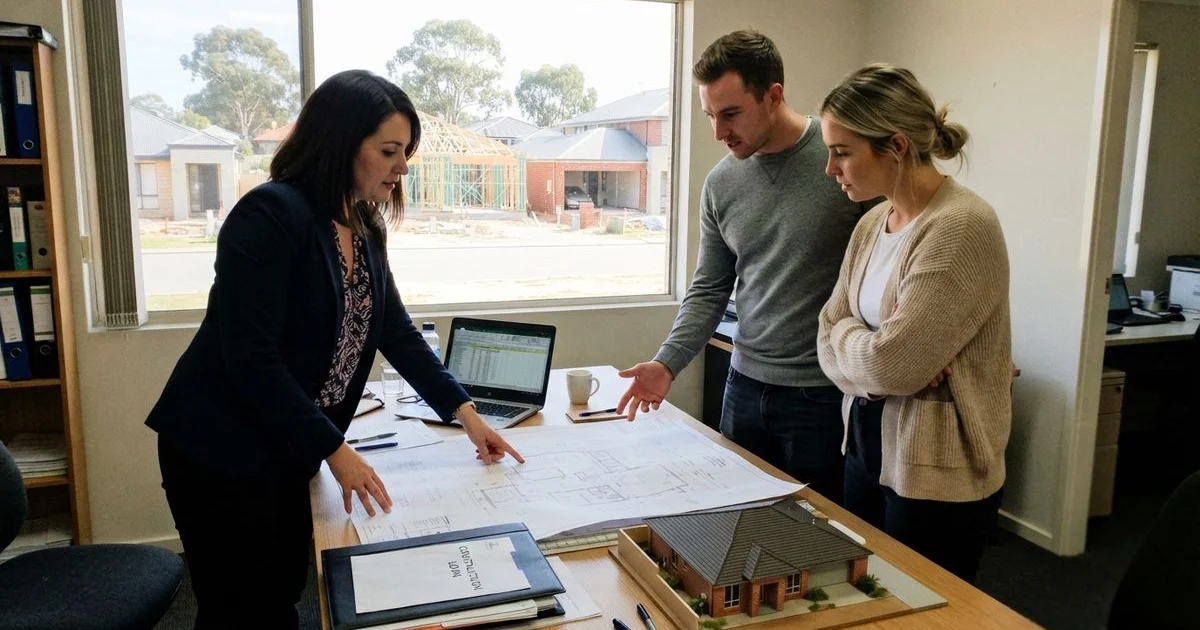
A construction loan pays your builder in stages as your home is built, usually a deposit plus 5 build stages, instead of paying out the full loan at settlement. Your builder invoices at each stage, the lender checks the work and pays the builder directly, and you pay interest only on the money drawn so far. When the build is finished, the loan becomes the ongoing home loan you chose when you applied. Most lenders also offer construction loans for knock-down rebuilds and major renovations, but not for cosmetic work.
In WA, the Home Building Contracts Act adds 2 protections on top of the loan. Your builder can ask for a deposit of no more than 6.5% of the contract price before work starts. Every progress payment after that must be for work already done (WA Government, Building and Energy).
How a construction loan pays your builder: the stages
A construction loan follows your building contract’s payment schedule, usually a deposit plus 5 build stages. The percentages below are indicative figures published by ANZ, Bankwest and CommBank. Your own schedule is set by your contract.
| Stage | What is built | Share of the contract (indicative) |
|---|---|---|
| Deposit | Paid before work starts | About 5% (capped at 6.5% in WA for contracts of $7,500 to $500,000) |
| Base or slab | Site prepared and the slab poured | About 10 to 20% |
| Frame | Wall frames and roof trusses | About 15 to 20% |
| Lock-up | Roof, external walls, windows and doors | About 20%, and up to 40% in ANZ’s schedule |
| Fixing or fit-out | Internal linings, plumbing, electrical and fittings | About 20 to 30% |
| Completion | Painting, final details and site clean-up | About 10% |
Sources: ANZ construction loan handbook, Bankwest, CommBank.
At each stage, your builder sends you an invoice. You check the work, sign the invoice or a drawdown form, and send it to your lender. The lender may send a valuer to inspect the stage before paying the builder. ANZ, for example, says it needs 7 to 10 days to process a progress payment request.

Construction loan repayments during the build
Construction loan repayments start small and rise as each stage is drawn. You pay interest only on the amount paid to your builder so far, not on the full approved loan, and most lenders set repayments to interest-only during the build. NAB gives the example of a $250,000 loan where the first invoice, for the slab, is $50,000: interest is charged on that $50,000 until the next stage is paid. Early repayments stay small.
That lower early repayment helps if you are renting while you build, a cost NAB, Pepper Money and loans.com.au all tell you to budget for.
After the final payment, the loan switches to the repayment type you chose at application. For most borrowers that means principal and interest, and ANZ notes those repayments will likely be higher than during the build. Some lenders, including Bankwest and NAB, let an interest-only period continue if you chose one.
Construction loan costs and features
A construction loan can cost more than a standard home loan. Pepper Money says construction loan interest rates are often higher, and loans.com.au says the same applies to fees, especially valuation fees. CommBank charges a progressive drawing fee for each progress payment request, added to the loan after the final payment. NAB says that in most cases it does not charge an inspection fee. None of the 11 lender and comparison pages we checked publishes a dollar figure for these fees, so ask for them in writing.
Features can also be limited during the build. ANZ says redraw is not available while you are building, though its variable rate construction loan can have an offset account. Compare these details, not just the headline rate.
WA rules that protect your money during the build
The Home Building Contracts Act 1991 covers WA home building contracts with a fixed price between $7,500 and $500,000. It applies whether or not your builder is registered. According to Building and Energy, the WA regulator:
- Deposit cap: the most a builder can ask for before work starts is 6.5% of the contract price. Above $500,000 there is no cap.
- Progress payments: once work starts, payments must only be for work done or materials already supplied. A builder cannot claim for bricks until the bricks are on site.
- Home indemnity insurance: building work needing a permit and worth more than $20,000 must be covered. It can cover a lost deposit up to $40,000 and incomplete or defective work up to $200,000 if the builder dies, disappears or becomes insolvent.
- Before you sign: your builder must give you the “Notice for the homeowner”, which sets out your rights.
The rules fit together. The construction loan lender only pays for completed stages, and the Act only allows the builder to claim for completed work. Paying a builder ahead of the work, outside the loan, can weaken a claim on the home indemnity insurance.
Building and Energy’s fact sheet adds that the builder must take out home indemnity insurance and give you the certificate before asking for any payment, including the deposit (Home Building Contracts Act fact sheet). Ask for that certificate before you sign the drawdown for the deposit.
What a lender needs before approving a construction loan
Most lenders ask for 4 things before approving a construction loan. Until the build is finished, the security for the loan is a block of land and a set of plans, so the lender assesses the home as well as your income:
- A fixed-price building contract with a licensed builder, including the payment schedule. ANZ says cost-plus contracts may be considered only in exceptional circumstances.
- Building plans and specifications, and council-approved plans and permits before building starts.
- Builder’s insurance, such as builder’s all-risk and public liability, plus home warranty cover. In WA that is home indemnity insurance.
- Quotes for extra work outside the builder’s contract, such as a pool or shed.
The lender then values the property “as if complete”, based on the land and the finished home, and lends against that value. The lender’s loan to value ratio limit applies to it. Westpac says it generally requires a 20% deposit, and Canstar notes you may have to pay lenders mortgage insurance with a deposit under 20%.
Get pre-approval before you sign with a builder. ANZ, Pepper Money and loans.com.au all offer pre-approval before you choose a builder, and it tells you what contract price you can actually afford.
Your own money goes in first
If you are putting your own savings into the build, most lenders want that money spent before they release any of the loan. ANZ says you pay your cash contribution directly to your builder before the construction loan can be used.
Overruns work the same way. Bankwest only pays up to the amount in the progress payment schedule for each stage, and anything over that comes from your own funds. ANZ may cover a shortfall of less than $5,000 during the build, repaid at the end, while a larger gap has to come from your savings. Bankwest also warns that a variation or product change may need a brand new construction loan application.
Time limits on a construction loan
A construction loan has deadlines. ANZ and CommBank both require the build to be finished within 24 months of the first progress payment, and ANZ says undrawn funds may not be available after that. CommBank also requires construction to start within 12 months of the disclosure date on your loan contract. ANZ requires your first drawdown within 6 months of your letter of offer.
Delays from weather or materials are common enough that the WA Government notes builders may issue a variation extending the completion date. If your build is running late, tell your lender early, not at the deadline.
Land and construction loans in WA
If you are buying land first, you can hold a separate land loan and add a construction loan later, or combine the 2 into 1 facility. ANZ says you can keep them separate or combine them, even if the land loan is with another bank.
First home buyers in WA pay no transfer duty on vacant land up to $450,000, with a concession up to $550,000, for agreements from 7 May 2026 (WA Government). The $10,000 First Home Owner Grant applies to building a new home. On a contract to build, it is paid after the first construction progress payment, usually slab down, and once your name is on the certificate of title (RevenueWA FHOG lodgement guide). A deposit to the builder does not count as that payment. Our guide to first home buyer grants and schemes in WA covers the caps.
At completion: the final payment
Before the last payment, the lender carries out a final inspection or valuation to check the home matches the plans. Lenders also ask for proof of building insurance and, where your state requires one, an occupancy certificate. Arrange home insurance before the final stage: ANZ asks for the certificate of currency before it releases the last payment.
Once the final payment is made, CommBank says your contracted loan term, typically 30 years, starts at that point.
How a broker fits in
190 businesses are listed in our construction and building loans directory. Construction lending rules differ between lenders on time limits, cost-plus contracts, owner builders and how shortfalls are handled, so a broker can match your build to a lender before you sign a contract. Our page on construction loan progress payments explains the drawdown paperwork, and you can check a broker’s credit licence before you apply.
Checked against lender pages, Building and Energy WA, RevenueWA and the WA Government on 26 September 2026. This is general information, not financial advice. It does not consider your objectives, financial situation or needs.
Frequently asked questions
How does a construction loan work?
A construction loan releases money in stages as your home is built, usually a deposit and 5 build stages. The lender pays your builder directly after each stage is invoiced and checked. You pay interest only on the amount drawn, and the loan becomes a standard home loan when the build is finished.
How much deposit does a construction loan need?
Westpac generally asks for a 20% deposit. Canstar says you will typically need at least 5%, and may pay lenders mortgage insurance below 20%. Separately, a WA builder can ask you for a deposit of no more than 6.5% of the contract price before work starts, for contracts between $7,500 and $500,000.
Do I pay interest on the full construction loan?
No. You pay interest only on the money paid to your builder so far. On NAB’s example of a $250,000 loan, interest after the slab is charged on the $50,000 drawn, not the full $250,000.
How long do I have to build?
ANZ and CommBank require the build to be finished within 24 months of the first progress payment. CommBank also requires construction to start within 12 months of the disclosure date on your loan contract.
What if my build costs more than quoted?
Lenders generally pay only up to the amount in your progress payment schedule, so you cover any overrun from your own funds. ANZ may bridge a gap of less than $5,000 during the build, repaid at the end. Bankwest says a variation may need a new construction loan application, so tell your lender before agreeing to changes.
When is the WA grant paid on a build?
The $10,000 WA First Home Owner Grant applies to building a new home. It is paid after the first construction progress payment, usually slab down, once your name is registered on the certificate of title.
Frequently asked questions
- Is a construction loan more expensive than a standard home loan?
- Rates are sometimes slightly higher, and there can be extra fees for progress inspections. The bigger practical difference is usually how the loan is structured and drawn down, rather than a large gap in the interest rate itself.
- How much deposit do I need for a construction loan?
- Requirements vary by lender, but expect a similar or sometimes higher deposit expectation than a standard purchase, partly because lenders are financing a property that doesn't exist yet and want a buffer against cost overruns.
- What happens if the build costs more than the contract price?
- You're generally responsible for the shortfall, whether through additional funds you've saved or an increase to the approved loan if the lender agrees. This is why getting a fixed-price contract and a contingency buffer sorted before you start matters.
- Do I need land finance and a construction loan separately?
- Sometimes, particularly if you're buying land first and building later. Some lenders offer a combined land and construction facility, while others treat them as two separate applications. A broker can help you work out which structure suits your build timeline.