
Refinancing after separation in WA: your home loan options
By Nathan Ellis · Updated 2026-07-26
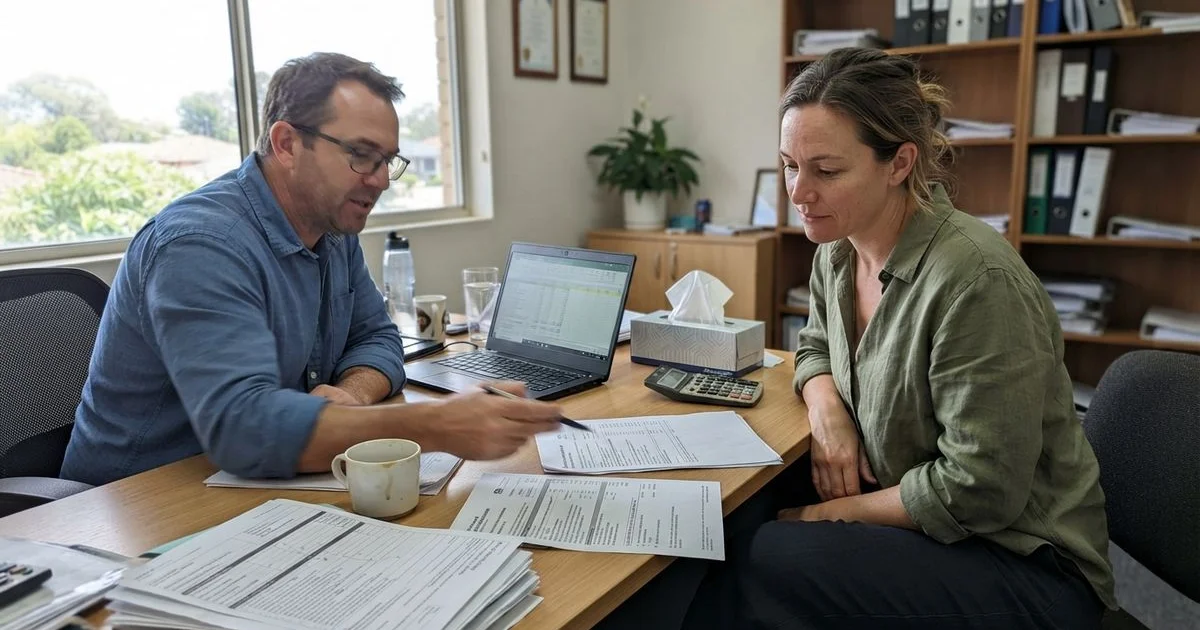
After a separation in WA, a joint home loan usually ends in 1 of 3 ways. One of you refinances into their own name and buys the other out, you sell and split what is left, or you keep the loan jointly for a while. Until the loan is refinanced or paid out, you both stay fully responsible for it. If one of you does not pay, the other has to pay the full amount (Moneysmart).
WA adds 2 rules worth knowing early. A transfer of the home under a Family Court order or financial agreement pays only nominal transfer duty. And the time limit to start a property case is 12 months after divorce for married couples, or 2 years after separation for de facto couples.
Your 3 options at a glance
| Option | What it needs | When it tends to fit |
|---|---|---|
| Refinance into 1 name | The person keeping the home qualifies for the new loan alone, including any buyout amount | 1 of you wants to keep the home and can carry the loan on a single income |
| Sell the property and split | Agreement on the sale and on how the proceeds are divided | Neither of you can, or wants to, keep the home alone |
| Keep the joint loan for now | Ongoing cooperation and repayments from both of you | Short-term stability matters more, for example while children finish a school year |

Separating does not change who owes the loan
A joint home loan stays joint after you separate. Moving out or a private agreement does not remove anyone from the mortgage, and the lender still holds both of you to the mortgage contract. Both borrowers stay liable until the loan is refinanced into 1 name or discharged.
Keep the repayments up while you work out the settlement. If money is tight, call the lender early and ask about hardship options. Our guide on struggling with mortgage repayments covers what to ask.
Refinancing into your own name
To keep the family home, the person staying usually refinances the existing mortgage into their sole name. A refinance into 1 name is a new loan, assessed on your income, expenses and debts alone, and you need to show you can service the loan by yourself. The fact that the joint loan was affordable for 2 incomes does not carry over.
Lenders assess the new loan at a higher rate than you will actually pay. APRA requires banks to test your repayments at least 3 percentage points above the loan rate, and confirmed that buffer in May 2026 (APRA). On a 6.24% loan, the rate the RBA reported for new owner-occupier loans in July 2026, the lender checks you could manage repayments at 9.24% or more. The serviceability buffer glossary entry explains how that works.
Get a realistic figure early, before you agree to keep the home. Our borrowing power calculator gives a starting point, and a broker can test it against several lenders’ policies.
Working out a buyout
A buyout loan has to cover the existing mortgage balance plus the amount you pay your ex-partner for their share of the equity. A worked example:
- The home is valued at $700,000 and the loan balance is $400,000, so the equity is $300,000.
- The property settlement gives your ex-partner 50% of that equity: $150,000.
- The new loan in your name is $400,000 plus $150,000, so $550,000, before refinancing costs.
- $550,000 on a $700,000 home is a loan to value ratio of about 79%.
The split in your settlement may not be 50%. In WA there is no automatic 50:50 split in a property settlement (Legal Aid WA); the court looks at contributions and future needs. Use the figure in your agreement or orders, and base it on a current lender’s valuation, not on what you paid.
Add the refinancing costs on top: discharge and application fees and a new valuation. Our guide on whether refinancing is worth it lists them.
Stamp duty on transferring the home in WA
In WA, a transfer of the home to 1 of you after the relationship breaks down pays nominal duty, not transfer duty at the general rate. The transfer has to be made under a Family Court order or a financial agreement (RevenueWA fact sheet).
The conditions matter:
- The relationship must have irrevocably broken down.
- The property must be property of the marriage or de facto relationship.
- It must go to 1 or both of you, your children or their trustee, or a trustee of your super fund. A share transferred to anyone else, such as a parent, pays duty at the general rate on that share.
- The transfer and the court order or agreement are lodged with RevenueWA within 2 months of the order or agreement being made.
If you have already paid full duty, you may be able to apply for a reassessment at the nominal rate. The order or agreement has to come into existence within 12 months of when the duty liability arose, and you apply within 5 years of that.
Time limits for property settlement in WA
The deadline to start a property case depends on whether you were married or in a de facto relationship (Legal Aid WA):
- Married: within 12 months of the divorce becoming final. A divorce becomes final 1 month and 1 day after the divorce order is made. If you are separated but not divorced, there is no time limit yet.
- De facto: within 2 years of separating.
After the deadline you need the court’s permission, and Legal Aid WA says there is no guarantee it will be given. You can only apply for a divorce once you have been separated for at least 12 months. De facto couples have the same property rights as married couples in WA.
Getting the order of steps right
The legal settlement and the refinance run side by side, but the settlement usually comes first. A lender usually needs to see what the settlement gives each of you before it can finalise a refinance.
A sequence that avoids most surprises:
- Get a borrowing capacity figure from a broker early, before you agree to keep the home.
- Agree the settlement with legal advice, formalised as consent orders or a financial agreement.
- Refinance into 1 name, pay out the old joint loan, and transfer the title, lodging the duty paperwork within 2 months.
How a broker fits in
320 businesses are listed in our refinancing directory. A mortgage broker can model whether you can keep the home, what the buyout loan would be and which lenders would accept your income on its own, so you go into the settlement with real numbers. That is finance help, not legal advice: the settlement itself needs a family lawyer, and Legal Aid WA has free information on dividing property.
Checked against Moneysmart, APRA, RevenueWA and Legal Aid WA sources on 26 September 2026. This is general information, not financial or legal advice. It does not consider your objectives, financial situation or needs.
Frequently asked questions
Can I refinance a joint loan into my name?
You can refinance a joint home loan into your own name if a lender approves you for the full loan on your income alone. The new loan is assessed from scratch, with repayments tested at least 3 percentage points above the loan rate under APRA’s buffer. Being on the original joint loan does not guarantee approval.
Does a court order remove me from the mortgage?
A Family Court order divides the property between you, but it does not change the loan contract with the lender, which has 2 borrowers until it is refinanced or paid out. Your name comes off the mortgage when the loan is refinanced into your ex-partner’s name or paid out. Until then you both stay responsible for the repayments.
How much do I borrow to buy out my ex?
A buyout loan equals the current loan balance plus your ex-partner’s share of the equity. On a $700,000 home with a $400,000 loan and a 50% equity share, that is $400,000 plus $150,000, or $550,000, before refinancing costs.
What if I cannot refinance on my own?
If no lender will approve the mortgage in your name alone, the usual options are to sell the property and split the proceeds, or to keep the joint mortgage for a set period while you both keep up the repayments. If a family member offers to guarantee the loan, read being a guarantor for your child’s first home loan first for the risks the guarantor takes on.
Is there stamp duty on a WA separation transfer?
A WA transfer after separation pays nominal duty, not transfer duty at the general rate, if it goes to 1 or both of you. It has to be made under a Family Court order or financial agreement after the relationship has broken down. Lodge it with RevenueWA within 2 months of the order or agreement.
What is the WA property settlement time limit?
Married couples in WA have 12 months from the date the divorce becomes final. De facto couples have 2 years from separation. After that, you need the court’s permission to start a property case.
Frequently asked questions
- Can I refinance a joint home loan into my own name alone?
- Often yes, if your income and borrowing capacity support the full loan on your own. The lender assesses you individually as if applying fresh, so approval isn't automatic just because you were part of the original joint loan.
- What if my ex-partner won't cooperate with refinancing?
- This becomes a legal matter as much as a finance one, and usually needs to be resolved through family law processes, including a formal property settlement, before a lender can act. A broker can advise on the finance side, but legal advice is essential here.
- Does my share of equity affect how much I need to refinance?
- Yes. If you're buying out your ex-partner's share, the loan amount typically needs to cover their equity payout on top of the existing balance, which changes the borrowing capacity required.
- Is it better to sell than refinance after separation?
- There's no universal answer. It depends on whether one person wants to and can afford to keep the home, the property market, and what's agreed as part of the property settlement. A broker can model both scenarios so you're deciding with real numbers.